hugiml-core documentation
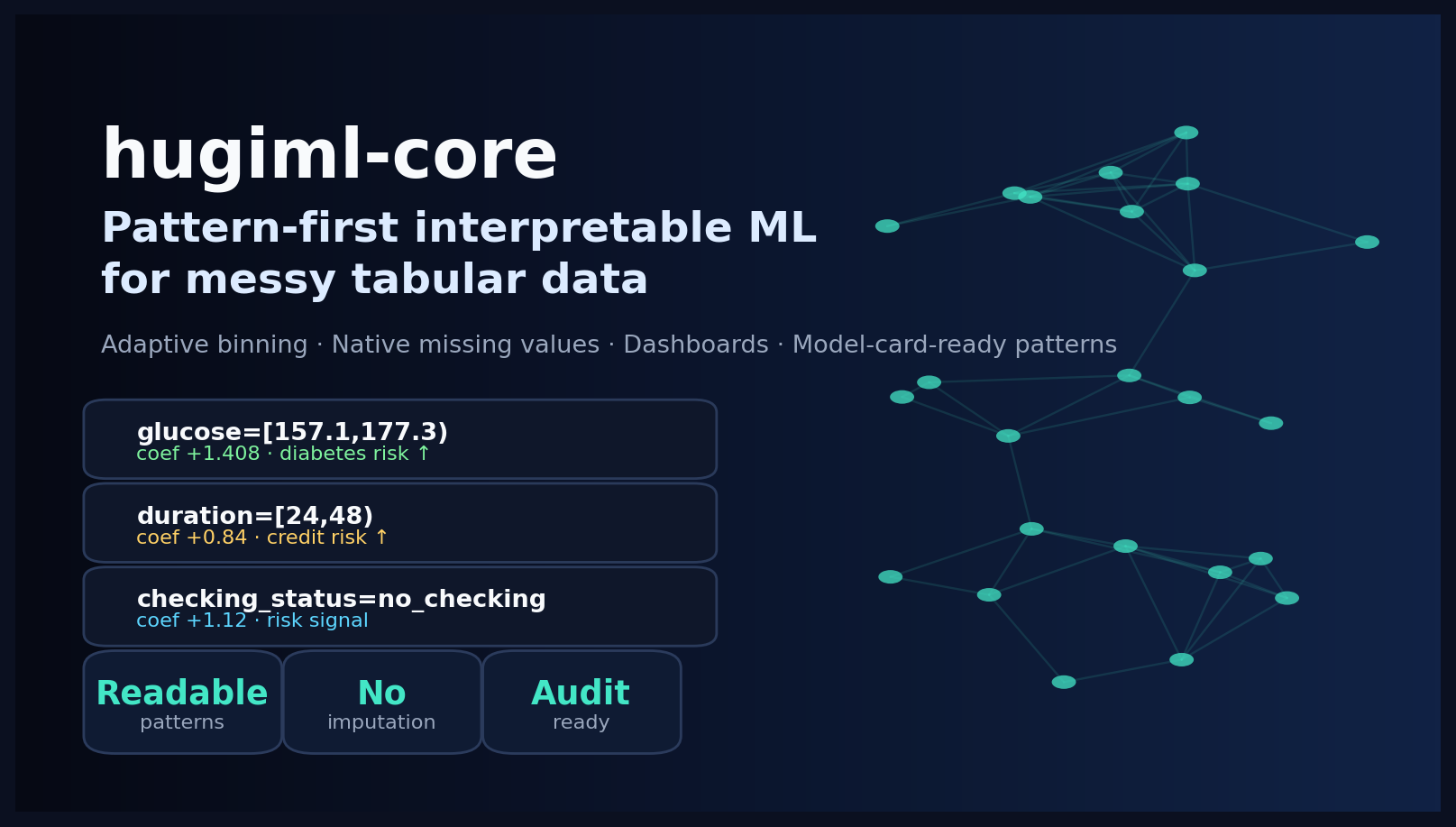
hugiml-core is a high-performance implementation of the HUG-IML framework for intrinsic interpretable machine learning on tabular data. It learns High Utility Gain patterns, converts input rows into a binary pattern-presence representation, and fits an interpretable downstream classifier on top of those patterns.
The package is designed for teams that need competitive tabular classification with explanations that can be reviewed as intervals, categories, supports, utilities, information gain values, and coefficients rather than as post-hoc approximations of a black-box model.
Why HUGIML?
Intrinsic interpretability: learned HUG patterns are the model representation, not an after-the-fact explanation.
Regulated-domain fit: model cards, audit artifacts, pruning trails, calibration, drift monitoring, and deployment helpers are included.
Native performance: computationally intensive mining, transaction construction, interaction-information scoring, pair-aware adaptive binning, matrix construction, and RPTE tree search are C++ accelerated with optional OpenMP support. Version 1.1.19 improves RPTE representation clarity, modularizes the classifier implementation, and adds rich on-demand data profiling to the Dash workbench while retaining the complete 1.1.x feature set.
Python ergonomics: the estimator follows the scikit-learn API and works with pandas DataFrames or NumPy arrays.
Current release focus
The 1.1.19 release strengthens model representation, maintainability, and data review without changing the public estimator contract:
RPTE retains higher-order mined patterns as direct sparse terms and consolidates an equivalent leaf-pattern representation into one canonical model component. The omitted representation remains available as an audit alias, so interpretation and complexity views do not count the same fitted component twice.
The classifier implementation is organized into focused internal modules for preparation, training, feature assembly, prediction, interpretation, inspection, tuning, and estimator state.
HUGIMLClassifierandHUGIMLClassifierNativekeep the same public behavior.The Dash workbench includes a compact data-profile preview and an expandable, on-demand profile with sample or full-data scope, raw-data and model-input views, variable roles, quality findings, missingness, distributions, correlations, and target associations.
A reproducible OpenML-CC18 workflow evaluates 36 classification datasets on their official task-defined splits and assembles a static comparison dashboard with performance, runtime, and inspection-efficiency summaries.
Dashboard model configuration uses consistent Default, Guided, and Advanced run modes for HUGIML and comparison estimators.
The complete 1.1.x documentation remains in this guide, including execution modes, adaptive binning, feature modes, augmented-pair features, RPTE, mining controls, explanations, monitoring, deployment, and benchmark workflows.
Installation
pip install hugiml-core
pip install "hugiml-core[plots]"       # optional Plotly dashboards
pip install "hugiml-core[benchmarks]"  # optional comparison suite
pip install "hugiml-core[dashboard]"   # optional Dash and Streamlit interfaces
pip install "hugiml-core[llm]"         # optional LLM assistant
Paper reference
The implementation is based on:
Krishnamoorthy, S. (2024). Interpretable Classifier Models for Decision Support Using High Utility Gain Patterns. IEEE Access, 12, 126088–126107. DOI: 10.1109/ACCESS.2024.3455563.
User guide
- Getting started
- Core concepts
- Feature modes
- Execution modes
- Augmented pair features
- RPTE downstream model
- Complexity units
- Fast hyperparameter tuning
- Native mining pruning controls
- Explanations and dashboards
- Governance Studio dashboard
- LLM assistant add-on
- Governance, pruning, and model cards
- Monitoring, drift, and serialization
- Deployment
- Benchmarks
- Worked notebooks
- Publishing on Read the Docs
- Paper and scientific scope
API reference
Project